The 100-hour battery has found its first customer: Big Tech


The 100-hour battery has found its first customer: Big Tech
Most long-duration storage companies are raising money for a market that might not go mainstream until the 2030s. The ones that can compete with Lithium will be the ones that stop waiting for it.
In the last week of June 2026, the wind stopped blowing across South Australia. Output from the state’s wind fleet fell to roughly 4.5% of capacity and stayed there for four days, the area's worst wind lull since 2019. Gas and imported electricity struggled to fill the gap, so wholesale prices shot up to the market ceiling of A$20,300 per megawatt-hour, against an average of A$88 in the first quarter of 2026.
Batteries helped catch the first extreme price peak, but they weren’t designed for such a long wind drought. By the second price spike, almost all were empty and unable to supply the grid.
Europe will soon face a version of this scenario. Wind and solar supplied 30% of EU electricity in 2025, and are modeled to reach 56% by 2030, then up to 86% by 2050. Once renewables are responsible for above 70% of electricity generation, energy storage must serve beyond daily peaks. It must cover the multi-day lulls when renewables can't meet demand. Europe averages 1.6 of these 'dunkelflaute' events a year, mostly between November and January, and 41% last longer than three days.
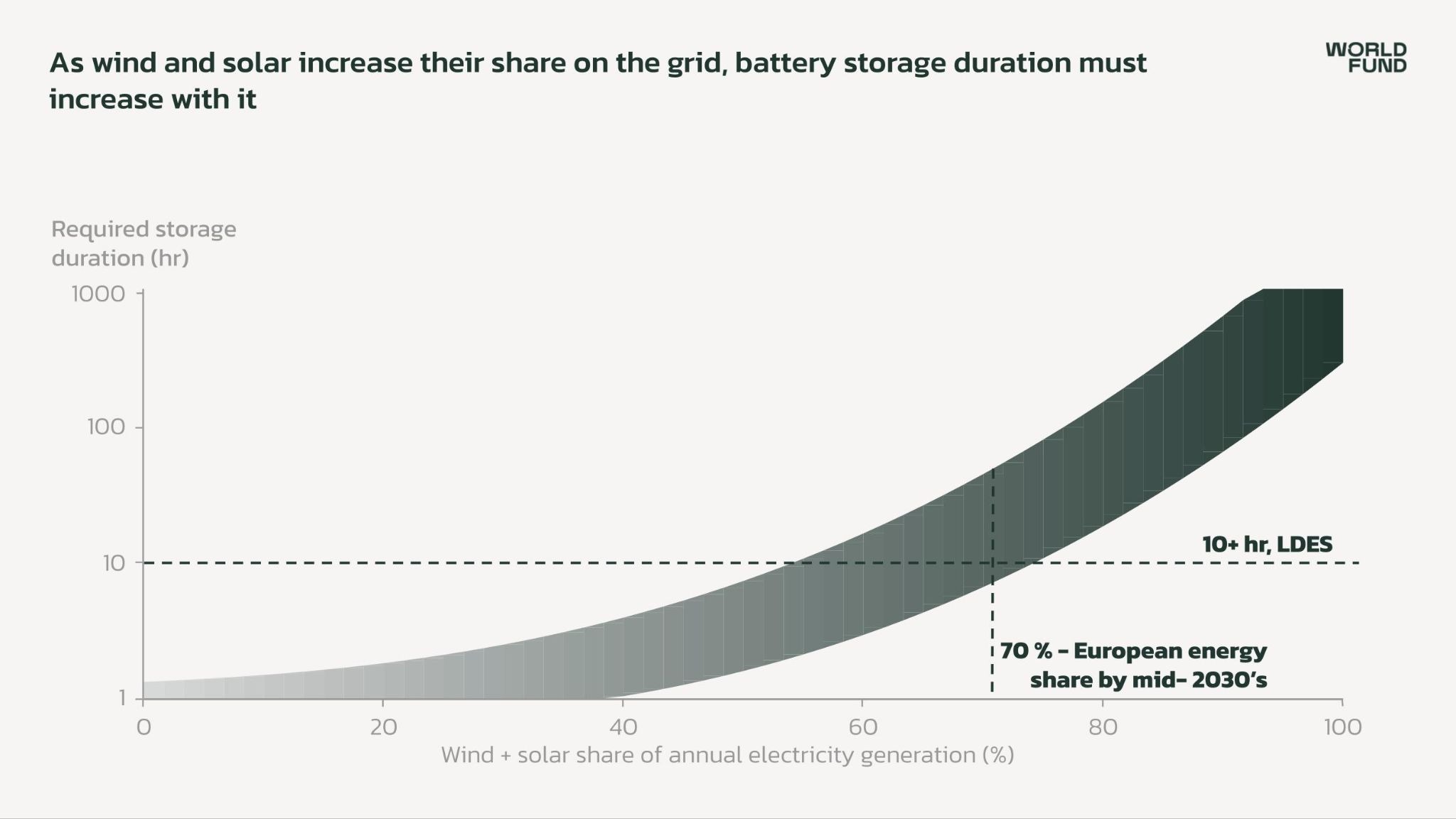
Figure 1: Required storage duration against wind and solar share of generation (Source: Albertus, Manser and Litzelman, Joule 2020)
How long is long duration?
There is no fixed definition of long-duration energy storage, or LDES. The US Department of Energy uses ten hours or more and California twelve, while Britain's cap-and-floor scheme requires eight hours at continuous rated power. Eight is a typical threshold, and lithium-ion can already reach these durations. RWE's 50 MW / 400 MWh (8 hours) Limondale battery in New South Wales went into full operation in May 2026. A subcategory of LDES is Ultra-LDES (ULDES), which generally refers to durations of 100+ hours. Overall, this covers a single becalmed day through to shifting summer sun into winter demand.
Today, around 90% of installed long-duration capacity worldwide is pumped hydro. Although it has been widely used for decades, geographic and permitting constraints have stalled further development. For example, the last big wave of US pumped hydro storage construction was in 1985.
This means that the remaining 10% of technologies, or new ones, will need to drive future LDES deployment. Currently, most of that new capacity is lithium-ion batteries, but emerging alternative technologies are designed for long-duration operation. This deep dive evaluates the prospects and opportunities of these emerging technologies.
Three families of technologies
Electrochemical
Sodium and zinc promise cheaper raw materials and a European supply chain. However, they compete directly with lithium and, with a similar cell structure to Li-ion, the manufacturing advantage currently sits in China.
Redox flow is the most established alternative, as vanadium is proven. However, it is expensive and concentrated in China. Challengers are pursuing iron, manganese-hydrogen, zinc-polysulfide and (solid) organic chemistries. Among them is Germany’s CMBlu Energy, which passed a €1bn valuation on the initial close of its Series C. Low degradation means that these batteries can be cycled more frequently than Li-ion. But at these shorter durations, they are in direct competition with Li-ion, and no technology has reached price parity with Li-ion as of yet.
Iron-air, using a rusting reaction, is on the other end of the duration spectrum. It targets discharges of 24h+ and has attracted significant capital recently. Form Energy raised $750m in August 2026 at a pre-money valuation of $1.75bn, and in Europe, Ore Energy, raised $43m the same month. The low RTE may mean that Iron-air deployments are treated more as an insurance backup for extreme events than a frequently cycling battery.
Mechanical
Mechanical storage (compressed air, liquid air, CO₂, gravity and pressure-geothermal) stores energy as thermodynamic or gravitational potential energy. Some of these technologies are well established.
Hydrostor builds compressed air storage and secured a $230m financing package in August 2026. Highview Power has 350 MW of liquid-air storage under various stages of construction. Energy Dome's CO₂ battery reaches 70–75% round-trip efficiency, higher than liquid air, and has a commercial agreement with Google. Its main constraint is the footprint of the large low-pressure dome that holds the CO2. Sage Geosystems pumps water into deep rock and discharges it by releasing the pressure, with the option to recover additional heat from the rock below. Gravity has, so far, proven harder to operate successfully at scale. Energy Vault, which began with crane-and-block systems, now deploys lithium-ion predominantly.
Thermal
Electricity is converted to heat and stored in a sensible heat medium (such as fire brick or sand), a phase change material (such as molten salt), or via thermochemical storage. Using this thermal energy as industrial heat has a much higher RTE than reconverting it to electricity. This could help unlock industrial heat decarbonisation, where global demand is around 116 EJ/yr and contributes to about a fifth of global CO2 emissions. However, deployment remains small relative to demand.
A low cost of added energy results in cheaper installed CAPEX at longer durations
Duration is defined as the battery's energy divided by its power. In a lithium-ion (Li-ion) cell, the energy and power are directly coupled. Therefore, to increase duration, a controller must limit the battery's power. The most promising LDES technologies decouple energy and power instead. Duration can be increased simply by adding more energy capacity to the battery, whilst keeping power the same. An example of this is a redox-flow battery, where the power is fixed by the cell stack, and the energy is determined by the volume of the electrolyte (the energy storage medium) tanks used. Larger tanks accommodate more electrolyte and therefore result in a longer-duration battery.
This is best represented by the cost of installed CAPEX per kWh:
Installed CAPEX, $/kWh = (cost of power, $/kW) / (duration, hr) + (cost of added energy, $/kWh).
From this equation, it is clear that the longer the duration, the more the added-energy cost dominates. With Li-ion, the cost remains comparatively constant. Stationary storage packs averaged $70/kWh in 2025, though Chinese storage cell prices rose more than 20% in the six months to April 2026 as lithium prices more than doubled. With the redox-flow and iron-air examples in Figure 2 below, there is an initial higher cost of power but a lower cost of added energy. This shows that different power and energy costs create windows where a particular technology is cheapest.
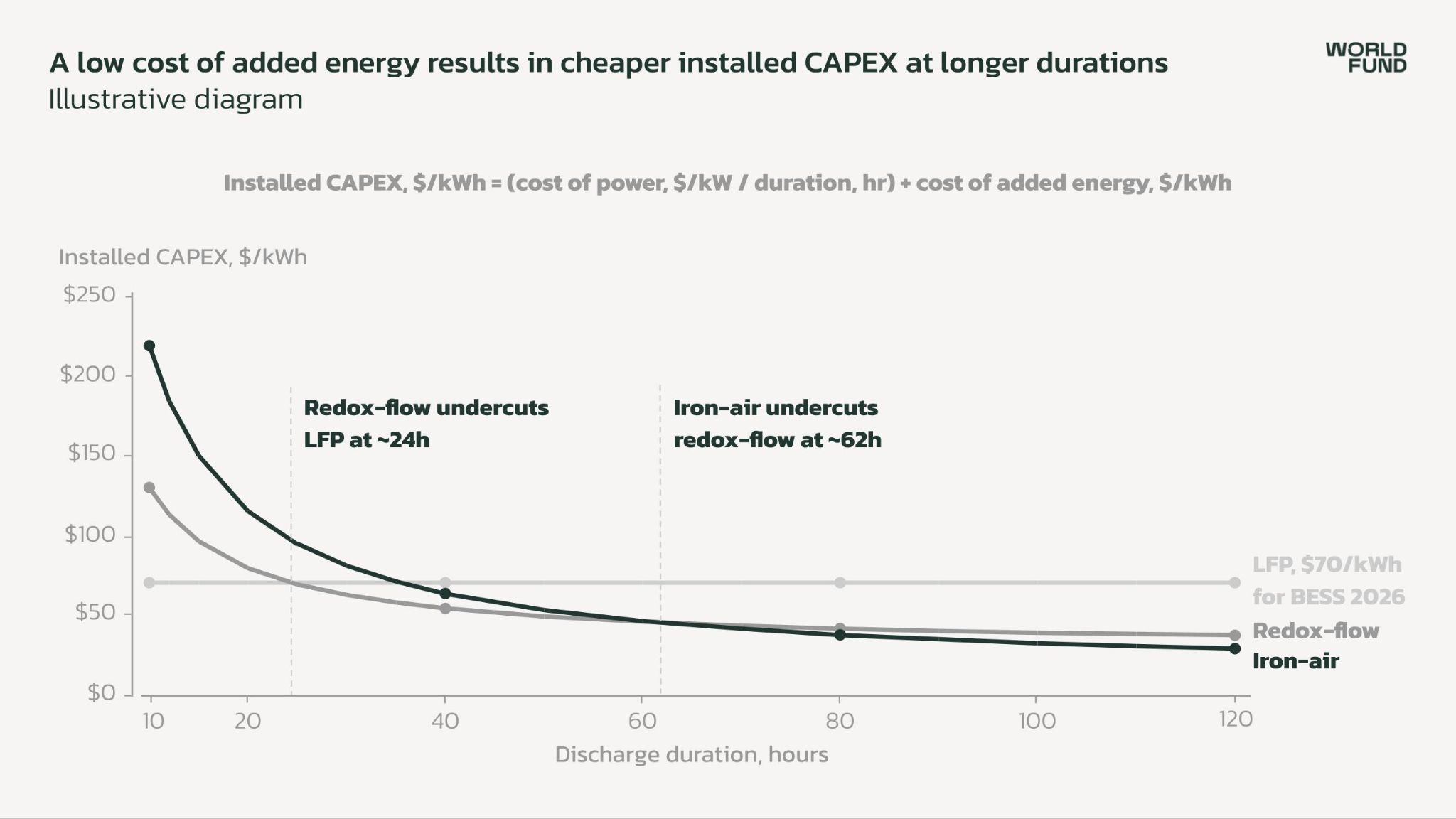
Figure 2: Installed capex per kWh against round-trip efficiency, by technology category. Illustrative only. (Source: World Fund analysis)
That graph is illustrative, though, and the redox flow and iron-air technologies have not reached the maturity or scale to be able to compete on price with lithium (yet). In fact, a shortlist for a governmental LDES support scheme in Great Britain, cap & floor Window 1, lists a Li-ion battery rated for 18 hours. Plummeting prices for Li-ion mean the technology already serves most current LDES requirements (still measured in hours, not days), creating a difficult environment for emerging technologies to compete on cost.
A high round-trip efficiency is necessary for profitable margins, but lower can be tolerated for longer durations
Round- trip efficiency (RTE), the share of energy surviving a charge and discharge cycle, sets how much of a price spread can be kept as revenue. This is significant, for example, at 50% efficiency, buying at one price and selling at double leaves the operator a net revenue of zero. Lithium sits near 92% and pumped hydro near 80%. Many of the alternative LDES technologies have RTEs of 80% or lower. Iron-air, for example, currently operates around 50%. An iron-air battery is an LDES system that generates electricity through a reversible chemical reaction between iron and oxygen. Lower RTEs are only viable at longer durations where (cheap) batteries are only cycled when necessary, when the gap between low and high prices is at its widest (in the Australian example, you could buy at $80 and sell at $20k; your round-trip efficiency affects you less than 0.4% of profits in this case).
Grid pressure is growing, but energy markets do not yet pay for duration
Grid share of wind and solar in Europe is expected to cross the 70% LDES threshold in the mid-to-late 2030s. Therefore, there isn’t yet an urgent market necessity for grid-scale LDES.
That leaves multi-day storage with a business-model (revenue) problem. A 100-hour battery that charges and discharges at the same rate needs about 200 hours per full cycle. That caps it at around 40 cycles a year, against a daily or bi-daily cycle for lithium battery cycling daily (365+). Arbitrage alone will not pay back that asset. Someone has to pay for the capacity it holds in reserve, like the UK or through a regulated revenue floor, like the one Germany plans to introduce by 2027, or a long-term contract with a buyer such as a data centre or wind park.
A small number of initiatives are beginning to open the energy market to LDES. The UK’s cap-and-floor scheme guarantees a revenue floor for 20 to 25 years while also setting an upside cap and lets the operator keep everything in between. Ofgem, Britain’s energy regulator, has provisionally selected 16 projects, all but two being either pumped hydro or Li-ion. The assets will come online by 2030 and will validate whether this approach is the best way to incentivise LDES deployment.
The fundamental challenge is that policy is slow and reactive. LDES developers may wait a decade for comprehensive policy incentivising LDES deployment to become widespread. Furthermore, technologies vying for investment need existing validation. They must be able to demonstrate sustainable revenue generation and technological reliability.
There is a large near-term market arising from grid islanding
A swelling grid connection queue, which in the US has reached a median of 5 years, has brought in a new customer for LDES: hyperscalers. Every day of delay costs a 100 MW data center around $1 million. This means that many, up to 30% by 2030, will avoid a grid connection altogether and operate as an island grid. If this is powered by on-site renewables, it must be coupled with battery storage that not only provides daily balancing, but also an “always-on” power supply. The need for speed to power is so great that hyperscalers are willing to offer substantial contracts with LDES providers. This is already evident in Google’s partnership with Energy Dome and (through Xcel Energy) Form Energy, and Meta's partnership with Noon Energy.
Companies and technologies that secure these initial deployments will have a valuable near-term revenue stream and, crucially, the opportunity to validate operational reliability.
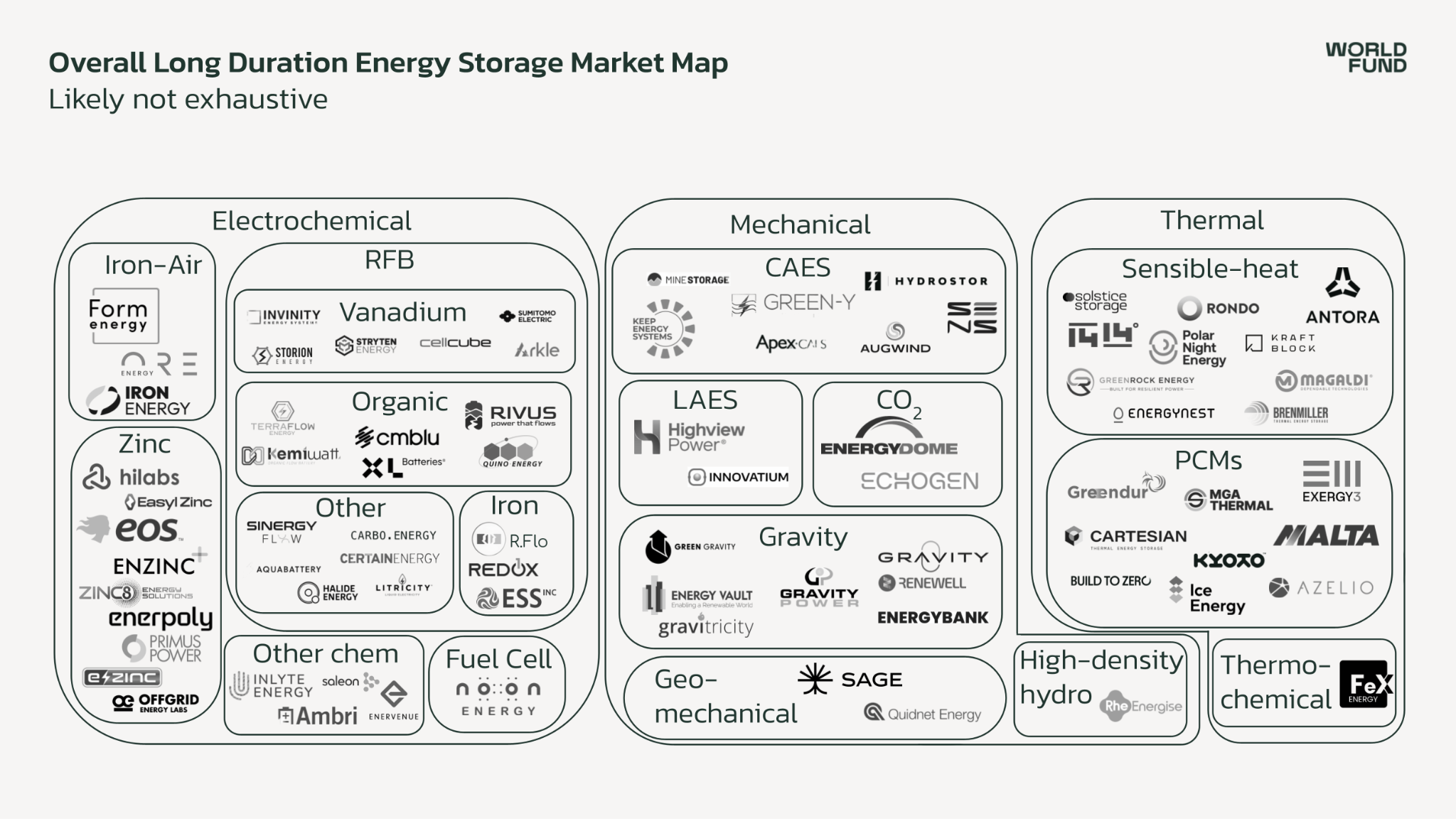
Figure 3: The long-duration energy storage landscape by technology category, September 2026 (Source: World Fund analysis)
The climate case
Power generation emitted 15.6 Gt CO2e in 2024, 27% of the global total. Long-duration storage cuts these emissions indirectly, by taking work from the gas plants that run only at peak hours and by soaking up renewable output that would otherwise be switched off (an increasing proportion of new capacity). The LDES Council and McKinsey put the category's potential at 1.5-2.3 Gt CO2e/yr by 2040, mostly in the 8 to 24 hour band.
Where we see the opportunity
- You need to be cheaper than lithium beyond 15 hours
- Under $20/kWh of added energy
- Above 80% round-trip (if you cycle daily)
- Have a European manufacturing route that can be globally competitive
- And, in an ideal case, an ease of manufacturing scaleup at reasonable cost
The technologies we believe are most likely to be secure against Li-ion are either ULDES, which Li-ion fundamentally can’t compete with, or a battery (or total system) that can operate over a range of durations, generating revenue from daily arbitrage while also providing valuable long-duration energy capacity at low additional cost. ULDES is the safer of the two from lithium, but it is also the more exposed to the alternatives below.
LDES is not the only way to firm a renewable grid, and for the rarest events it may not be the cheapest. Germany plans to tender 10 GW of new gas plants that can run for long stretches, to be online by 2031. For multi-week droughts, gas is probably the right answer for this decade. Covering a 55-day event from storage pays off only if storage capacity costs around $1/kWh, the level at which storage could replace all firm low-carbon generation. At $20/kWh or less, storage can cut electricity costs by 10% or more. That is where we see the opportunity: batteries that earn from daily price swings and also cover the multi-day lulls Europe sees more than once a year. A small, rarely used gas fleet can handle the last weeks of a bad winter.
Firm clean power changes this only if it arrives cheap and soon. Ontario's first BWRX-300 small modular reactor is due by the end of 2029, and Commonwealth Fusion Systems' first plant in the early 2030s. Enhanced geothermal is further along. Fervo's Cape Station began commercial operation with 33 MW in October 2026 and is due to reach about 100 MW by January 2027. If these technologies succeed at scale, they will take share from multi-day storage first, and much less from storage that earns its money every day. A nuclear or geothermal plant runs at the same output day and night, so it fills the gap a windless week leaves, which is the job multi-day storage is paid for. It does little to the daily swing between cheap midday solar and the evening peak, which is where a daily-cycling battery earns.
In practice, we look for storage that is cheaper than lithium at 15h and beyond, adds energy for less than $20/kWh, keeps average round-trip efficiency above 80% if it is to cycle daily, and has a manufacturing route that can scale in Europe. Capex costs for scaling new production are important here, as if the new technology looks like a standard lithium ion battery, Europe may find it difficult to compete on cost with China.
Grid demand for 15h+ arrives as wind and solar pass 70% of European generation in the mid-to-late 2030s, and support schemes like cap-and-floor are only now being tested. Until then, the companies we want to back are the ones already signing contracts with data centers, because those first deployments build the reliability record grid operators will want to see and allow for scaling to get to the cost points that can be competitive with Lithium in the medium term.
The grid today doesn’t pay for duration, data centres do, and a 100 MW data centre losing a million dollars a day is the only buyer in Europe currently willing to sign a contract that values the 50th hour.
Our position is narrow. We are not funding seasonal storage; gas will do that job more cheaply for a decade, and fusion, SMRs, or geothermal may take it after. We are not funding better lithium with a European flag on it. We are funding storage that beats lithium beyond 15 hours, adds energy for under $20/kWh, cycles often enough to earn every day, and has a buyer today who isn’t a grid operator. There are fewer of those than the funding announcements suggest. If you are one of them, get in touch.
If you are innovating in this sector, please get in touch at craig@worldfund.vc or mark@worldfund.vc.